Neurographic Installation
Community is a foundational unit of the society, no matter what cultural or historical background it originates from. I am not anthropologist or social scientist, just an observer…it seems to me that the community is much more than a sum of individuals forming it.
Individuals and groups forming and integrating into a community gather around common interests and goals that further the prosperity and the well being of the community; in doing so, they are willing to sacrifice some of their own individual freedoms and conveniences for the benefit of the community. And they do that with, or for, the sense of personal fulfillment and belonging. Not unlike Kibbutz communities in Israel I visited few years back. Communistic and entrepreneurial at the same time…
The question (for our group) is how to express this concept, a tension between the individual and the community, in an artistic form or intervention…with the focus on connection that govern these relations.
Upon much pondering, we embarked on the following art experiment – unlike the first installation we created, where the individuals were loosely linked into the ‘common interest’ group, our second installation will (or is meant to) project a unity where artistic individuality is subdued to serve the common goal of an esthetically more unified and interactive art piece – a community.
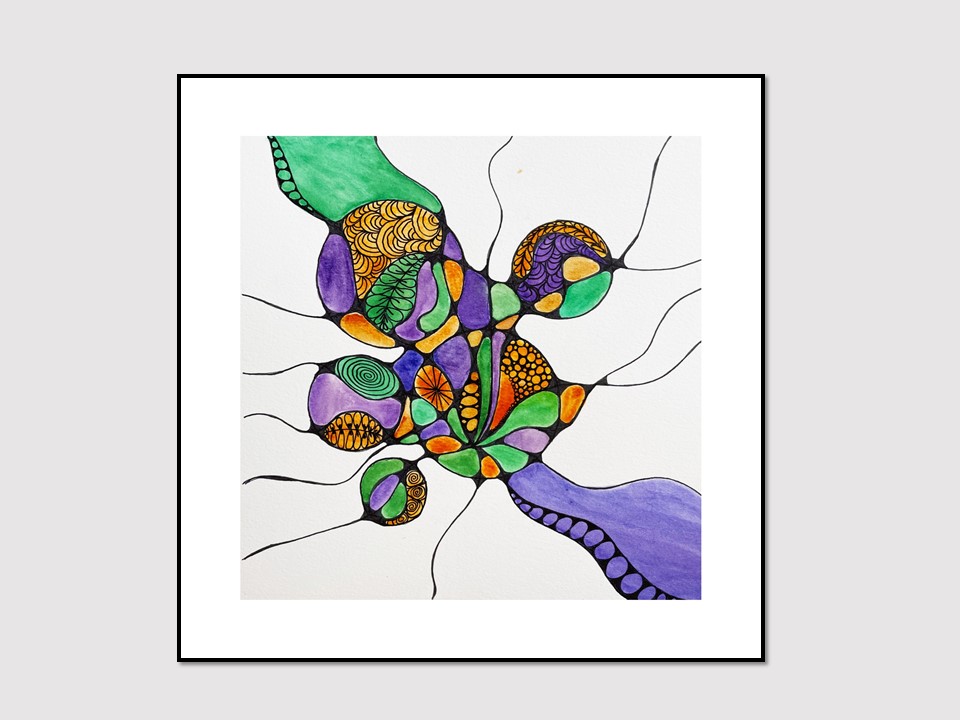
To achieve this goal, we introduced a set of rules that limited individual freedoms to create at will and had a purpose of unifying 12 paintings using pre-determined colors and motifs (for the benefit of a common esthetic goal). Some individual freedoms were allowed, as long as principal ‘rules’ governing the community were accepted and adhered to.
We created two colorful communities – ‘A Community of Primary Colors’ and ‘A Community of Uncomfortable Colors’.
The curiosity must be running wild among our followers to find out how these ‘community’ installations were assembled, what they meant, and, most of all, how did they ‘turn out’. Did the ‘community’ rules create more unified esthetic interpretation of connectivity to the installation assembled by a group of individuals? Was it more beautiful, in sync, unified?
Well, we, the creators, can’t tell. It is you, the viewers, who have to react. Did this experiment find the artistic way to examine, transmit, visually and intuitively, the transition from individual to community, and eventually to society, our uniquely human quality? Were our color communities connected in a harmonious or turbulent ways?
They were connected nevertheless, tentatively or substantively. The emerging esthetics of these connections remains curious (and as always subject to personal preference). Individual preferences may single out one of these groupings as the ‘artistic’ winner. Is it because the viewer is personally more inclined towards individuality (freedom of expression) or towards community values (restrained expression), or is it just a pure visual impact of these installation? These are questions to ponder…and when we find the answers, perhaps, they will be telling us things we did not know fully about ourselves and connections we make with people and communities in our lives.
 Left Brain Artists