Clay sculptures and figurines
Unlike paintings that create an illusion of space, objects occupy space. You can view them all around, front, back, side; they are palpably 3D.
Figurative or abstract, sculpture is all about dimensions. Space and our place in it.
Objects relate to each other and can be used in 3D installations. These interactions and cross-relations among ‘objects’ is their enormously enriching ‘fourth’ dimension; their stand in and relation to the surrounding space is their ‘fifth’ dimension. Think of Stonehenge as an ancient example of an abstract sculpture installation of multiple ‘ones’ interacting with each other, with space and mind. Think of Marianna’s Mexican figurines arranged in ‘tableau’ scenes that recreate the mood of the country or experience…and that is how 3D becomes a 5D…
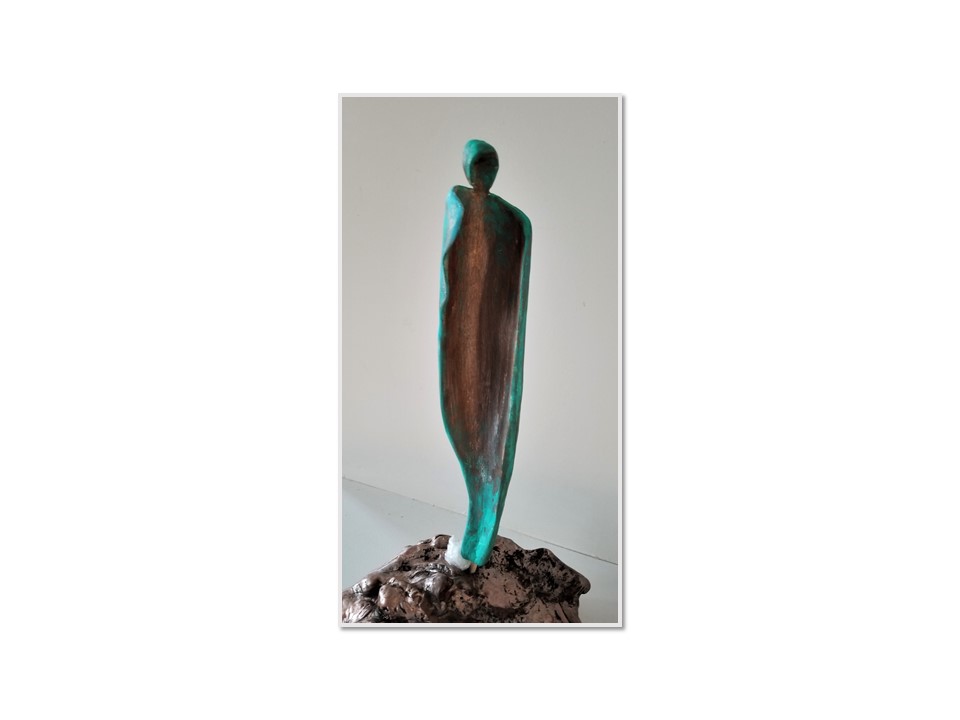
Two-dimensional objects can also ‘occupy’ the space – a movement, posture, shape that plays with space, painting illusion, display allowing ‘all around’ view – all can give essentially two-dimensional objects ‘a volume’ of sculptures. The quintessential example of this are sculptures of Carol Gold, thin, expressive, dynamic and often arranged as interacting figures.
Creating in 3D is an arduous process. Aiming for the end-result is based in conception. It is hard to imagine a sculpture spawned ‘out of nowhere’, instant. Too labor- and planning- intensive for an unbridled spontaneity. Yet, something about space that replicates our own existence in 3D (or 5D), a posture, a face expression, an interaction with other objects or surroundings is mesmerizing.
The following is a short exploration of how simple-shaped figures placed in a space can capture movements, life-stories, relationships, and emotions.
 Left Brain Artists